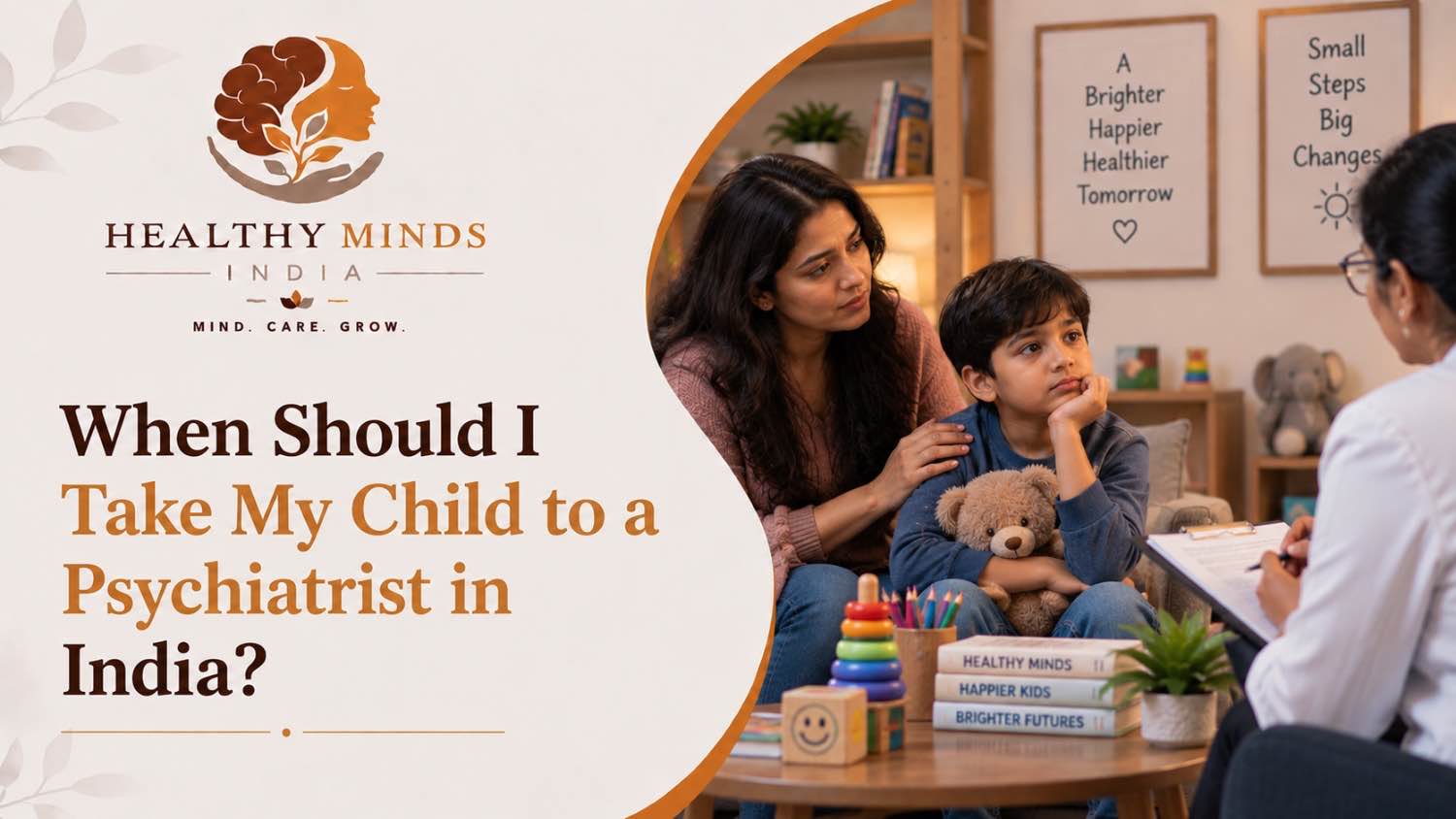
How do you tell ordinary childhood behaviour from something that needs evaluation? The signs worth taking seriously, and what a first visit actually involves.
In this article 8
- Signs Worth Getting Evaluated
- Why a Child Psychiatrist, Not Just a Paediatrician
- What Actually Happens at the First Visit
- Common Conditions Seen in Child Psychiatry
- Treatment Usually Starts With Guidance, Not Medication
- What This Looks Like in Practice
- Frequently Asked Questions
- Conclusion: Early Evaluation Is Rarely the Wrong Call
Every child has hard days, mood swings, and phases that worry a parent. The difficult part is telling the difference between ordinary childhood behaviour and something that genuinely needs professional evaluation - and most parents are not sure where that line is.
Here are the signs worth taking seriously, and what actually happens when you take a child to a psychiatrist in India.
Signs Worth Getting Evaluated
- A noticeable, sustained change in behaviour or mood - withdrawal, irritability, or sadness lasting weeks rather than days.
- A drop in academic performance that is not explained by a change in school, teacher, or workload.
- Difficulty with attention or impulsivity that is clearly out of step with other children the same age, across settings, not just at home or only at school.
- Social withdrawal or loss of interest in friends, activities, or things the child previously enjoyed.
- Extreme anxiety around separation, specific situations, or without a clear trigger at all.
- Any mention of self-harm or a wish not to exist - this warrants prompt evaluation, not a wait-and-see approach.
- Developmental concerns flagged by a paediatrician, teacher, or your own observation, particularly around communication, social interaction, or repetitive behaviours.
Why a Child Psychiatrist, Not Just a Paediatrician
A general paediatrician is often the right first stop and can rule out physical causes, but ongoing evaluation and treatment of conditions like ADHD, anxiety, depression, or autism spectrum concerns is the specific training of a child and adolescent psychiatrist. This sub-specialisation matters: assessing a child requires different tools, communication approaches, and diagnostic judgment than assessing an adult.
What Actually Happens at the First Visit
A thorough child psychiatry evaluation usually involves the child directly, but also draws heavily on input from parents and, often, teachers - since behaviour at school and at home can differ meaningfully. Expect questions about developmental history, school performance, family context, and specific behaviours, not just the immediate concern that prompted the visit. Standardised questionnaires are frequently used alongside the clinical conversation to structure the assessment.
Common Conditions Seen in Child Psychiatry
| Condition | What It Typically Looks Like |
|---|---|
| ADHD | Persistent inattention, impulsivity, or hyperactivity across settings, affecting school and relationships |
| Autism spectrum concerns | Differences in social communication, restricted interests, or repetitive behaviours, usually noticed early |
| Anxiety disorders | Excessive worry, separation difficulty, or specific fears interfering with daily functioning |
| Depression in children/teens | Persistent low mood, irritability, withdrawal, or loss of interest, sometimes presenting as anger rather than sadness |
| Oppositional or behavioural difficulties | Persistent defiance or conflict beyond typical developmental testing of limits |
Treatment Usually Starts With Guidance, Not Medication
For many childhood conditions, the first line of treatment is parent guidance and behavioural therapy, with medication considered when symptoms are more significant or not responding sufficiently to these approaches. This is a deliberate, evidence-based sequencing, not medication avoidance for its own sake.
What This Looks Like in Practice
At Healthy Minds India, child and adolescent evaluations with a psychiatry doctor in India involve parents and, where useful, schools, as part of a complete assessment rather than a rushed diagnosis. If you are also weighing cost as part of this decision, see this breakdown of what a psychiatrist consultation typically costs in India.
Frequently Asked Questions
-
At what age can a child see a psychiatrist in India?
Child and adolescent psychiatrists assess children from early childhood through the teenage years; the approach and tools used are adapted to the child's age.
-
Will my child be put on medication immediately?
Not usually. Most childhood conditions start with behavioural strategies and parent guidance, with medication considered if needed after that.
-
Should I tell the school if my child is seeing a psychiatrist?
Often it helps, since teacher input can inform the assessment and classroom accommodations can support treatment, but this is your decision to make with the psychiatrist's guidance.
-
What is the difference between a child psychologist and a child psychiatrist?
A child psychiatrist is a medical doctor who can diagnose and prescribe medication if needed; a child psychologist provides assessment and therapy but cannot prescribe.
-
My child's teacher suggested an evaluation. Should I be worried?
Not necessarily worried, but it is worth taking seriously. Teachers see patterns across many children and often notice things early that are genuinely worth a professional look.
-
Can autism be diagnosed by a psychiatrist in India?
Yes, though it typically involves a comprehensive evaluation, often with input from psychologists and developmental specialists alongside the psychiatrist.
Conclusion: Early Evaluation Is Rarely the Wrong Call
If a change in your child's mood, behaviour, or development has lasted weeks rather than days, or a teacher or your own instinct has flagged a concern, an evaluation by a child and adolescent psychiatrist is a reasonable, low-risk next step - not an overreaction.
Medically reviewed by Dr. Saurabh Kumar, Consultant Neuropsychiatrist, Healthy Minds India, Patna. This article is for general education and is not a substitute for a personal consultation. To discuss your situation, book an appointment or contact the clinic.
Disclaimer: all characters and events depicted in this blog are entirely fictional. Any resemblance to actual persons, living or dead, is purely coincidental. The content is intended for informational purposes only and should not be considered medical advice. Always consult a qualified healthcare professional for medical concerns.