Confused about which mental health professional to consult in Patna? A clear breakdown of psychiatrists, psychologists, and neuropsychiatrists, and when to see each.
In this article 9
- The Short Answer
- Psychiatrist: When Medication or a Formal Diagnosis Is Likely Needed
- Psychologist: When Structured Talk Therapy Is the Main Need
- Neuropsychiatrist: When Brain and Mind Overlap
- What About a Counsellor or Therapist?
- Can One Person Need All Three?
- How to Decide Where to Start
- Frequently Asked Questions
- Conclusion: One Team, Fewer Handoffs
Families often default to searching for "the best doctor" in Patna without knowing which type of mental health professional actually fits their situation. Psychiatrists, psychologists, and neuropsychiatrists overlap in what they treat but differ in training and in what they are able to do.
Here is a clear breakdown of each, when to see which one, and a simple way to decide where to start if you are not sure.
The Short Answer
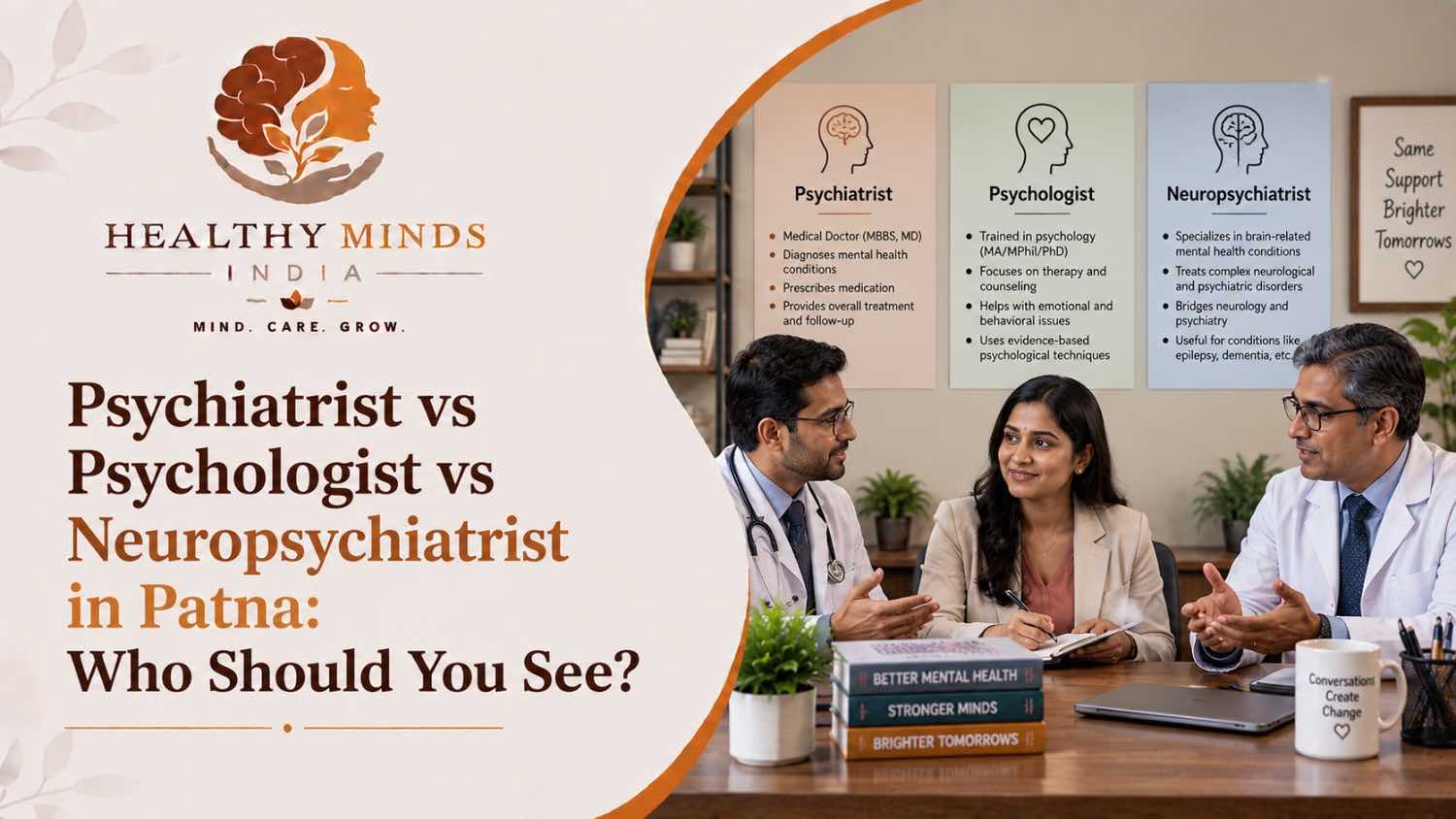
A psychiatrist is a medical doctor who can diagnose mental health conditions and prescribe medication. A psychologist typically handles assessment and structured talk therapy without prescribing. A neuropsychiatrist is a psychiatrist with additional training at the intersection of neurology and psychiatry - conditions where the brain and the mind overlap, such as treatment-resistant depression, epilepsy-related mood changes, or dementia. Many people need more than one of these together, which is why continuity of care under one clinical team matters.
Psychiatrist: When Medication or a Formal Diagnosis Is Likely Needed
See a psychiatrist when symptoms are affecting sleep, appetite, concentration, or daily functioning in a way that suggests a diagnosable condition - depression, anxiety disorders, bipolar disorder, ADHD, OCD, or psychosis, for example. A psychiatric evaluation typically covers your history, current symptoms, physical health, and any family history, and results in a working diagnosis and a plan.
A psychiatrist can order relevant investigations, arrive at a diagnosis, and prescribe and monitor medication where it is needed, adjusting dose and reviewing side effects over time. Many cases also involve therapy alongside medication, coordinated by the same clinician rather than two unconnected providers.
Psychologist: When Structured Talk Therapy Is the Main Need
See a psychologist when the primary need is structured talk therapy - working through grief, relationship distress, mild-to-moderate anxiety, or building coping strategies - without an obvious need for medication. Common approaches include Cognitive Behavioural Therapy (CBT), which focuses on identifying and changing unhelpful thought patterns, and supportive or psychodynamic therapy for deeper, longer-standing patterns.
Psychologists also carry out psychometric testing and detailed cognitive or behavioural assessments - for example, assessing a child for a learning disorder - that inform a psychiatrist's diagnosis when the two work together on a case.
Neuropsychiatrist: When Brain and Mind Overlap
See a neuropsychiatrist when psychiatric symptoms appear alongside a neurological condition, or when standard treatment has not fully worked. This includes treatment-resistant depression or OCD, mood and behavioural changes linked to epilepsy, dementia, or movement disorders, and cases being considered for non-invasive neuromodulation such as rTMS (repetitive Transcranial Magnetic Stimulation) or tDCS.
A neuropsychiatrist's training covers both fields, so the neurological and psychiatric sides of a case are assessed together rather than separately - which matters when, for example, a patient's low mood and a diagnosed neurological condition are closely linked and need one coordinated plan rather than two independent ones.
What About a Counsellor or Therapist?
"Counsellor" and "therapist" are often used loosely in India and do not always indicate a specific, regulated qualification the way "psychiatrist" and "clinical psychologist" do. If you are consulting someone under either title, it is reasonable to ask directly what their training and qualification actually is, and whether they work alongside a psychiatrist for cases that may need medical evaluation.
Can One Person Need All Three?
Yes, and it is common rather than unusual. Consider someone with long-standing depression that has not responded to two rounds of medication: they may need a neuropsychiatrist's evaluation for treatment-resistant options, a psychiatrist's ongoing medication management, and a psychologist's structured therapy - ideally without repeating their full history to three separate providers each time. This is one of the reasons psychiatric and psychological care are increasingly offered together under one clinical team, so nothing gets lost between appointments.
How to Decide Where to Start
- Symptoms are new, and you are not sure what is going on: start with a psychiatrist for a full evaluation.
- You know you need someone to talk to regularly, with no medication involved so far: a psychologist is a reasonable first step.
- Standard treatment has not worked, or a neurological condition is involved: ask specifically for a neuropsychiatrist.
- Not sure which applies: a psychiatric evaluation will usually clarify this and point you toward the right next step, including a referral if needed.
At Healthy Minds India in Patna, Dr. Saurabh Kumar is a consultant neuropsychiatrist, and psychological care is available under the same clinical team - so a diagnosis, medication review, and structured therapy can be coordinated without being handed between separate providers. Patients searching for the best psychiatrist in Patna for a complex or long-standing case often find that this continuity, rather than any single label, is what actually makes the difference.
Frequently Asked Questions
-
Can a psychologist prescribe medication in India?
No. Psychologists are not medical doctors and cannot prescribe medication. Only a psychiatrist (or another registered medical practitioner) can prescribe psychiatric medication.
-
Do I need a referral to see a neuropsychiatrist?
Not usually. You can consult a neuropsychiatrist directly, though a referral from another doctor is welcome if your case is already being managed for a neurological condition.
-
Can a psychiatrist also provide therapy, or only medication?
Many psychiatrists provide brief supportive counselling alongside medication, and often work with a psychologist for structured therapy when that is the primary need. Ask directly what is available.
-
Is a neuropsychiatrist the same as a neurologist?
No. A neurologist treats neurological disease itself (such as stroke or epilepsy) and does not typically manage psychiatric medication. A neuropsychiatrist is a psychiatrist with added training in how neurological and psychiatric symptoms interact.
-
Which specialist should I see for my child's attention or behaviour concerns?
Start with a psychiatrist or a specialist offering child and adolescent evaluation; conditions like ADHD are diagnosed and managed by a psychiatrist, often working alongside a psychologist for behavioural strategies.
-
What if my symptoms do not fit neatly into one category?
That is common, and exactly what a first psychiatric evaluation is for - it exists to sort out what is actually going on and direct you to the right next step, rather than requiring you to self-diagnose first.
Conclusion: One Team, Fewer Handoffs
The right title to search for depends on what you are dealing with - but when in doubt, a psychiatric evaluation is the safest starting point, since it is designed to identify whether you need medication, therapy, neuropsychiatric assessment, or some combination of the three. Choosing a clinic where all three are coordinated under one team means you explain your situation once, not three times.
Medically reviewed by Dr. Saurabh Kumar, Consultant Neuropsychiatrist, Healthy Minds India, Patna. This article is for general education and is not a substitute for a personal consultation. To discuss your situation, book an appointment or contact the clinic.
Disclaimer: all characters and events depicted in this blog are entirely fictional. Any resemblance to actual persons, living or dead, is purely coincidental. The content is intended for informational purposes only and should not be considered medical advice. Always consult a qualified healthcare professional for medical concerns.